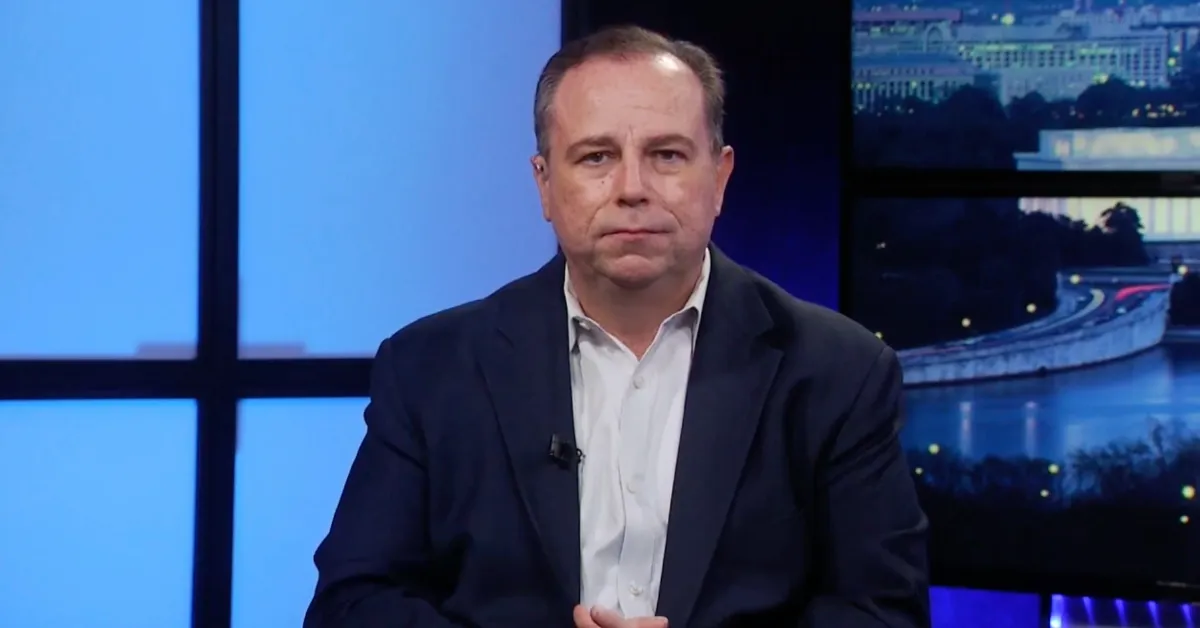
The founder and chief executive of cable news channel Newsmax has urged the Federal Communications Commission (FCC) to reject proposals from radio and television broadcasters to eliminate its rules regarding ownership, arguing the agency lacks the legal authority to carry out those wishes even if it wanted to.
In a reply filing submitted Wednesday, Newsmax CEO Chris Ruddy said the FCC lacks the legal authority to change the ownership cap, which the FCC set nearly two decades ago after being granted the authority through an act of Congress.
“The only thing the Commission will get if it alters the national television multiple ownership limit is a permanent injunction,” Ruddy warned, adding that Congress’ directive to establish a cap are binding.
Over the past few months, the broadcast industry’s lobbying group, the National Association of Broadcasters, has press the FCC and its Chairman, Brendan Carr, to eliminate the ownership cap. The broadcasters contend that the cap is the byproduct of a chapter in television and radio history that has since closed with the emergency of streaming video and audio platforms.
Broadcast TV and radio stations use wireless radio spectrum that is licensed and regulated by the FCC. By comparison, streaming apps and services like Netflix, YouTube and Apple Music do not. But the NAB contends that streaming services are treated differently because they are allowed to scale and grow their operations without onerous federal regulations, while the broadcasters who choose to use public air waves are subject to limitations.
Ruddy rejected this notion, saying Congress requires the FCC to impose an ownership cap, and that the agency isn’t allowed to unilaterally decide to eliminate it. Should the FCC choose to do so anyway, he warned that the matter will likely be challenged in court, and that the FCC is likely to lose.
Supporters of raising or eliminating the cap argue it is necessary to sustain local programming and compete with digital platforms. Ruddy countered that consolidation has historically harmed local media, pointing to the radio industry where deregulation in the 1990s left major groups like iHeart, Cumulus, and Audacy with heavy debt loads and forced a reliance on nationally syndicated content.
“Following the FCC’s relaxation of radio ownership regulations, many station owners relied heavily on debt financing to acquire additional outlets,” the filing stated. “This led to a reduction of local voices in an effort to minimize costs and meet debt service obligations.”
The company cited Nexstar’s recently announced $6.8 billion purchase of TEGNA as evidence that lifting the cap would primarily enrich executives and shareholders. That transaction, Ruddy said, would exceed current ownership limits and demonstrates that proposals to raise the cap are motivated more by financial gain than public interest.
Consumer costs are another point of contention. Ruddy aligned with cable and satellite advocates who argue that greater consolidation would drive up retransmission fees, which in turn are passed on to viewers.
“Consumers would have fewer choices and pay higher prices, the twin evils of dominant firms abusing their market power in highly concentrated markets,” Ruddy said.
Ruddy also took issue with a loophole called the “UHF Discount,” an analog-era rule that was meant to convince TV broadcasters to launch their stations on UHF channels when the technology was still new. The rule allowed TV station owners to count one UHF station by half reach, which allowed them to overcome some of the FCC’s ownership rules. All full-power TV stations transitioned to a new digital standard in 2009, and most TV stations now broadcast on UHF frequencies.
—
Read more: