

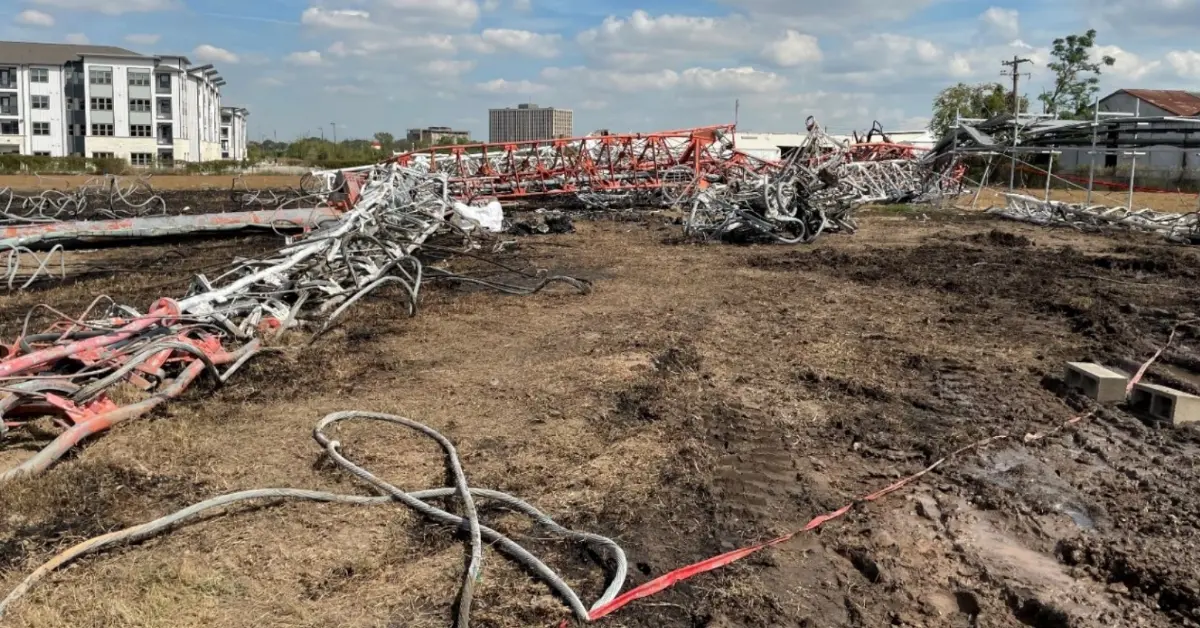
The family of several people who died on board a helicopter that crashed into a commercial radio tower in Houston last month have filed a $50 million wrongful death lawsuit against the owners of the helicopter and the tower.
The lawsuit is filed on behalf of Cesar Lerma, Marie Alonso and Dylon Lerma, the three passengers who were on board the tour helicopter when it crashed in Houston’s Second Ward neighborhood the evening of October 20.
The helicopter is owned by Porter Equipment Holding, which leased it to National Helicopter Solutions. That company was operating it for tourism purposes, after receiving approval from the Federal Aviation Administration (FAA) earlier in the month to conduct commercial sightseeing tours via helicopter, according to a National Transportation Safety Board (NTSB) report viewed by The Desk.
The owner of the tower, SBA Communications, had purchased the equipment from Univision earlier in the month. The tower was used to transmit several Univision-owned radio stations, which are now broadcasting from another tower in the city.
The family’s attorney, Randy Sorrels, said the lawsuit is intended to “get the attention of the entire industry,” saying the crash was “preventable,” but offering no specific information.
Sorrels’ comments made it seem as if the lawsuit was part of a fact-finding mission to figure out how the crash occurred in the first place.
“We hope to get down to the root cause of what caused this helicopter to crash into this communication tower, whether that involved the pilot, the equipment, the tower,” Sorrels told KUHF (88.7 FM). “There’s a lot of unanswered questions that we just want to get answered.”
The NTSB is also trying to get those answers. The agency typically concludes its investigations into aircraft crashes within 12 to 18 months of its occurrence, with a final report issued shortly thereafter, though some complicated crashes could take longer to probe.
The agency’s preliminary report said the pilot of the helicopter — identified by local news outlets as Samantha Grandbouche — was communicating with air traffic controllers in the minutes leading up to the crash.
Shortly before the collision, the air traffic controller had warned Grandbouche to maintain visual separation between her helicopter and another one that was providing a similar tour that evening. Grandbouche was in the process of reading back the request when her transmission abruptly ended. The NTSB believes that my have been when the helicopter struck the transmission tower.
While early media reports indicated the tower’s anti-collision lights were not functional that evening, surveillance video surfaced in the days after the crash that showed the top and middle lights blinking just before the helicopter impacted the structure.
The aircraft burst into flames on impact, then exploded again after slamming into the ground, killing all four people aboard. The tower collapsed a few seconds later. No one on the ground was injured.