


Penske Media Corporation, the owner of influential media and entertainment trade publications, has filed a lawsuit against Google, alleging that the company’s use of artificial intelligence summaries in search results is illegal and harms publishers.
The complaint, filed late Friday in federal court, marks the first time a major U.S. media company has challenged Google and its parent Alphabet over its AI Overviews feature, which surfaces machine-generated summaries at the top of search results. Penske says the practice siphons traffic from its websites, cutting into advertising, subscription and affiliate revenue.
“As a leading global publisher, we have a duty to protect PMC’s best-in-class journalists and award-winning journalism as a source of truth,” Penske Media CEO Jay Penske said in a statement. “We have a responsibility to proactively fight for the future of digital media and preserve its integrity — all of which is threatened by Google’s current actions.”
The lawsuit accuses Google of tying its traditional search indexing to participation in AI Overviews, leaving publishers with a Catch-22: allow their content to be repurposed for free into summaries that compete with their own sites, or remove themselves from search entirely. Penske claims about 20 percent of Google queries that include its content now display an AI Overview, and that the figure is climbing. It says affiliate revenue has dropped by more than a third since the end of 2024.
Google denies the allegations.
“With AI Overviews, people find search more helpful and use it more, creating new opportunities for content to be discovered,” Google spokesperson José Castañeda said. “Every day, Google sends billions of clicks to sites across the web, and AI Overviews send traffic to a greater diversity of sites. We will defend against these meritless claims.”
Penske Media is the owner of large-scale entertainment and media trade publications, including “Deadline Hollywood,” a weblog founded by journalist Nikki Finke in 2006.
While Deadline claims to be one of the victims of Google’s predatory business practices, it has engaged in some of its own: Four years ago, its media beat writer Dade Hayes repurposed a story from The Desk based on original reporting that concerned a pending deal between Roku and Warner Bros Discovery to add the streaming app HBO Max, which was then unavailable to users. Deadline cited The Desk, but didn’t link to the article — a common industry practice. When asked about the matter, Hayes said Penske had an internal policy that prohibited linking to other publications — which allowed Deadline to capitalize on The Desk‘s reporting, without providing any ancillary traffic back to the original source.
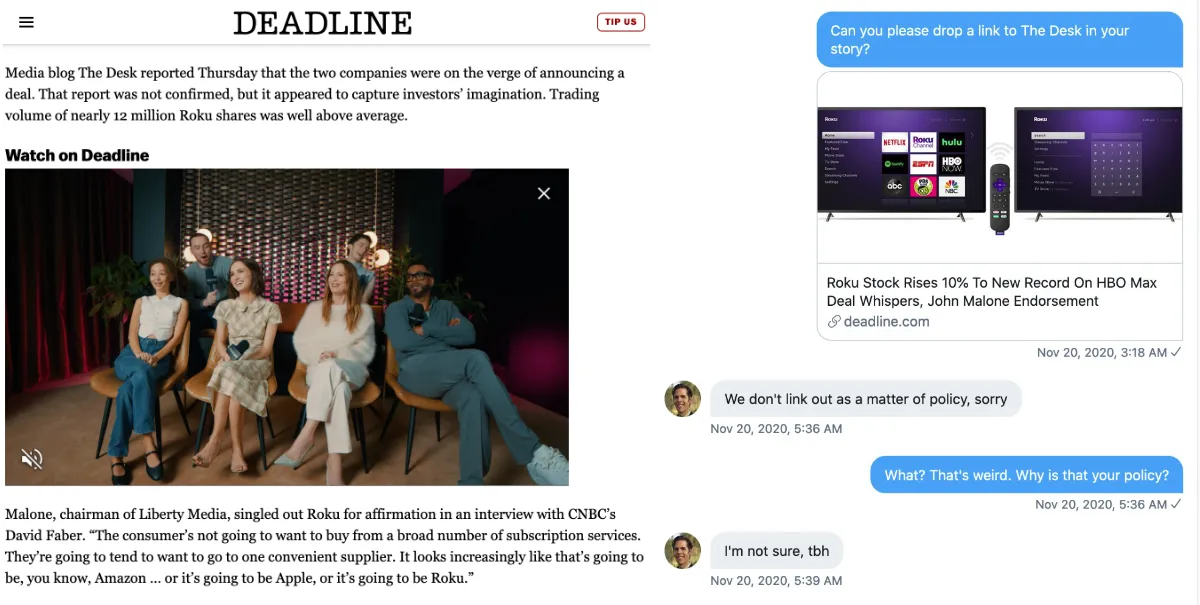
Penske now complains that Google does exactly the same thing by scraping information from its website and depriving it of web traffic, which serves as the foundation of its advertising and affiliation revenue models.
Deadline is one of more than a dozen plaintiffs listed in the case. The others include Penske-owned publications like Rolling Stone, the Hollywood Reporter, Vibe and Artform.
Other publishers and companies have filed similar complaints. Online education firm Chegg sued Google in February, while the Helena World Chronicle, a small Arkansas newspaper, has brought a proposed class-action lawsuit. In Europe, independent publishers have challenged Google over the same practice, and the News/Media Alliance has called the feature “the definition of theft.”
The Penske lawsuit comes as Google faces broader antitrust scrutiny. A federal judge last year ruled Google maintained an illegal monopoly in online search, though penalties were less severe than some regulators sought, citing growing competition from AI rivals.