
Special Coverage
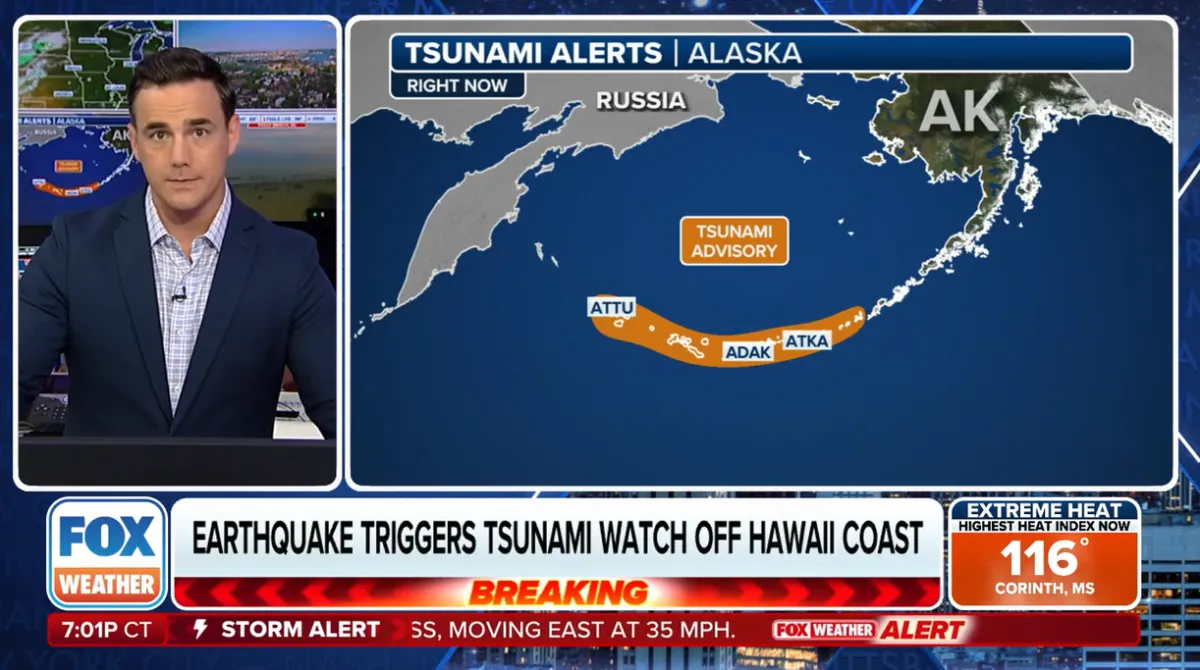
In the evening hours of July 29, Fox Weather meteorologist Steve Bender was wrapping up his coverage of a heat wave in the mid-Atlantic region of the United States when a large earthquake struck off the coast of Russia.
Earthquakes in the Pacific Ocean are not an uncommon — they tend to occur frequently between the western coast of the United States and the eastern coasts of Asia and Australia. But this was no common earthquake — it was a violent tremor that initially registered as a magnitude-6.9 before it was upgraded to a magnitude-8.8, the largest earthquake the world had seen in more than a decade.
That it occurred off the coast of Russia meant that country was unlikely to be the only one impacted — and, indeed, within minutes, the government-run U.S. Tsunami Warning Center had multiple bulletins that warned of possible tsunami waves that could impact several U.S. territory islands and the states of Alaska, Hawaii, Washington, Oregon and California.
Bender and the Fox Weather team immediately shifted their focus to the earthquake and subsequent tsunami. For more than 11 hours, the climate-focused channel updated viewers across broadcast, cable, streaming and audio platforms with the latest information about the event — from water measurements recorded by buoys in the ocean, to warnings from local officials in California and Hawaii about the anticipated time of arrival for the strongest waves, coupled with live video feeds, telephone interviews and curated images from social media.
Fox Weather meteorologists treated the tsunami threat with the seriousness it deserved. It stayed on the air overnight, long after the TV stations in Crescent City had switched to national and syndicated programming, and in the hours considered “fringe” in the TV broadcasting industry, Fox Weather was calling in meteorologists and producers to help further its coverage of the phenomenon.
Haley Meier was one of those meteorologists. The day before, she stood on the streets of New York City, covering the blistering heat. When her shift ended, she tried to go to sleep, but wound up glued to the coverage on her channel about the earthquake and the tsunami. A short time later, she was inside Fox Weather’s studios in midtown Manhattan, covering the situation with Ari Sarsalari on “Fox News at Night,” an overnight show she helped launched last year.
“I didn’t go to bed that night at all,” Meier said in an interview this week. She brought with her a case of Red Bull, which she split with her on-camera and behind-the-scenes peers.
“We can sometimes predict severe weather ahead of time, but with earthquakes and tsunamis, that’s the type of breaking news that you commonly see with general news — it’s unpredictable,” Meier said. “There was a good crew that came in, and we didn’t get to sleep.”
The worst of the tsunami caused flash flooding in some parts of Hawaii and more than $1 million in damage to infrastructure in the small California town of Crescent City. But, as the hours ticked by, it became somewhat clear that the worst-case scenario — a devastating coastal tsunami, like the kind experienced in Japan following the last major earthquake in 2011 — would not come to pass.
For Fox Weather, the multi-hour breaking news coverage was not an anomaly. The channel, which turns four years old this weekend, has committed itself to covering weather-related events wherever they take place, for however long it takes, and with as many resources as practical and possible.
Historically, that type of commitment was only made by cable networks during predictable, severe storms or unpredictable, large-scale events. In both cases, there needs to be an element of potential or actual large-scale devastation before a national news crew is committed. Often, it is a touch-and-go experience — one where a crew flies in, covers the storm or the aftermath of a wildfire, and then leaves a few days later.
That isn’t how things are done at Fox Weather. Long after a calamity, Fox Weather meteorologists and correspondents are on the ground, shining a spotlight on the various ways communities respond, pull together and persevere. And they occasionally step in to help.
Last year, Fox Weather meteorologist Bob Van Dillen was producing a live segment for the Fox News Channel on the aftermath of Tropical Storm Helene in Atlanta when he heard a woman crying for help. She was stranded in her car on a nearby flooded street, and Van Dillen realized that emergency crews, swamped with high-water rescues in other parts of the city, might take hours to get to her.
Van Dillen ended the segment early, waded into the waist-high water, and pulled the woman to safety. Video of the rescue aired on Fox News, and the woman was reunited with her husband during a live segment on Fox Weather about a half-hour later.
Van Dillen is remarkably humble — he didn’t want to draw too much attention to the rescue during subsequent Fox Weather and Fox News segments that day (though the video was hard to miss — the channels repeated the footage throughout the day, and local Fox stations and affiliates also picked it up, as did other outlets like NPR, the Washington Post and Time Magazine). During a phone conversation, he confirmed the two are still in touch — they exchange Christmas cards last year — and said he felt anyone in his situation would do the same thing.

Hurricane Helene was personal for Van Dillen: Atlanta is his hometown — before he joined Fox Weather, he worked for CNN and its sister network HLN (formerly CNN Headline News), both of which are headquarted in the city.
“I still live in Atlanta, and that was the one that hit close to home,” Van Dillen remarked during a phone conversation. “When landmarks get completely taken away, like street signs, things like that — in your hometown, you find it hard to get around, because the power is out, and all the roads are swamped. There are no street signs that are illuminated in your part of town. That is a scary situation. It’s unreal.”
Hurricane Helene wound up moving through Georgia into North Carolina, where it killed more than 100 people, becoming the deadliest weather event in that state’s history. Many parts of western North Carolina are still trying to overcome the devastating effects of the storm, and Fox Weather has dispatched reporters to numerous communities several times over the past year.
“(Fox Weather meteorologist) Jane Minar went down to North Carolina three times in the span of about six months, just to get a taste of how things are coming back, and if they’re going to come back,” Van Dillen said. “It’s really hard, because the infrastructure is totally destroyed. You’re talking about I-40, which if you’re familiar with the area down there, that’s a major transport area to get any kind of supplies in and out.”
The crews dispatched by Fox Weather aren’t seeking to capitalize on the destruction for ratings and views — their mission is to document the challenges each community faces in the aftermath of a consequential storm, and to shine a light on the various ways Americans pull together.
“There’s a beer company in Charlotte, a microbrewery, and right after Helene, they started putting water into cans and sending the water up into the mountains instead of beer,” Van Dillen recounts. “We interviewed them, and they couldn’t be more thankful that we were shining a light on the effort that they were doing, with the hopes that other people would see it and want to do the same thing.”
That story, and others like it, are part of a top-down ethos established by Fox Weather President Sharri Berg and embraced by all at the channel: To recognize that a story about a storm doesn’t end when the storm does, and to find the human elements of each event and bring those stories to the world.
Weather is something that affects everyone — a storm doesn’t care about a person’s political affiliation, gender identity, age or income level. Knowing this, Berg says it is important that Fox Weather make itself available on as many platforms as possible, and that viewers can tune in for free.
“Even if someone is just tuning into the stream for a minute or two and then leaving, the next time something major is going on, they’ll know where to go first,” Berg said. “That’s what we’ve seen in our data as we’ve grown over the years and as we’ve covered more events. When weather breaks, the viewership goes straight up. We become their choice. That is very strategic and very intentional, because our mission is to keep people safe. And that notion drives all of our decision-making processes.”
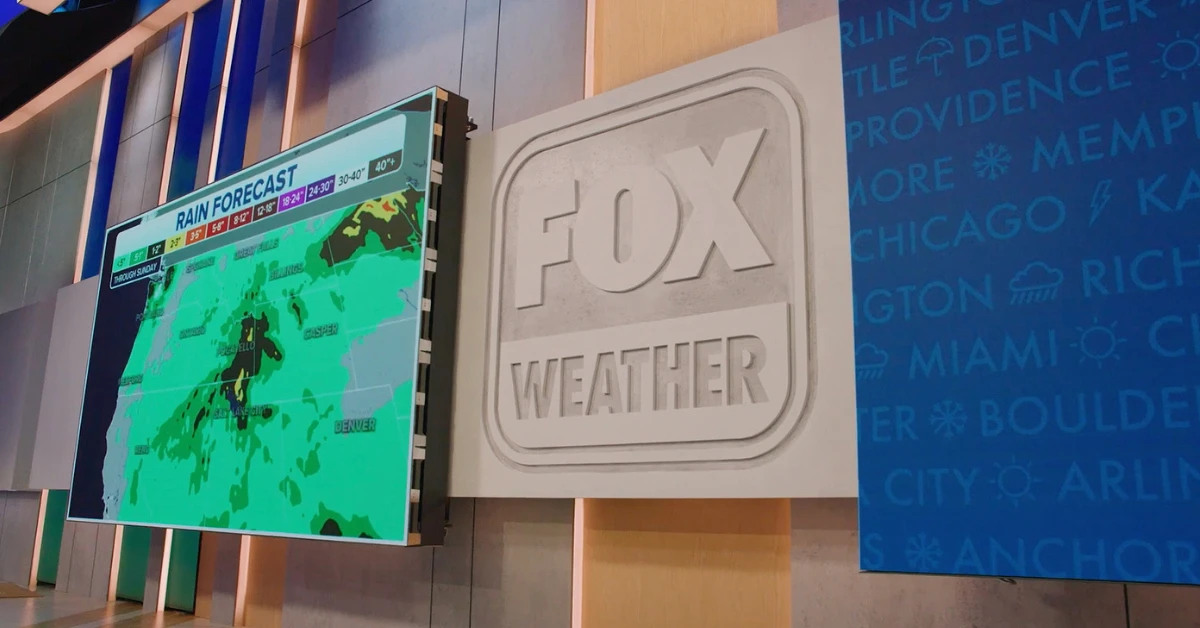
What originally started as a free weather app eventually evolved into a news channel that is widely available on free streaming apps like Pluto TV, Xumo Play, Plex and YouTube. It is also accessible from built-in apps on popular smart TVs made by Samsung, LG, Vizio and TCL and those running Roku and Amazon’s streaming operating systems.
Berg also recognizes that many news viewers still pay for TV service, so the network has forged distribution pacts with cable, satellite and premium streaming services. Dish Network, DIRECTV, Altice USA’s Optimum, Charter’s Spectrum TV, Comcast’s Xfinity TV and Verizon Fios all offer Fox Weather in the same TV packages as Fox News, as do streaming cable alternatives like Sling TV, Fubo, YouTube TV and Hulu with Live TV. (A few services offer Fox Weather without a subscription.)
Berg said that distribution model means viewers can usually access Fox Weather on the TV platform they use the most, without having to switch apps or inputs. And Fox Weather’s wide distribution on free streaming platforms means cord-cutters can still watch the channel when they churn out of a pay TV service. To Berg, that is important because a weather service that is committed to live coverage with life-saving information should make it easier, not harder, for viewers to tune in.
“Since we’re available everywhere, we don’t have to worry about converting our users from cable to streaming, or moving them from one platform to another,” Berg said. “The strategy is very seamless — if you’re watching Fox News, and Bret Baier says you can watch coverage of a storm’s landfall on Fox Weather, it’s not hard for a person to find it.”
Fox Weather: Everywhere
To Berg, that is important because a weather service that is committed to live coverage with life-saving information should make it easier, not harder, for viewers to tune in.
“As soon as you complicate the experience by asking for a password, it’s not very user-friendly,” Berg said. “Our long-term goal was creating an omni-channel experience…we’re not pushing anyone to anywhere, we’re just there.”
For viewers, that has made Fox Weather a visible lifeline during a climate-related emergency. And the channel has leaned into that responsibility by ensuring its life-saving broadcasts are extended to non-video platforms: A low bitrate audio simulcast is available on TuneIn, so people can listen to updates via their phones without using large amounts of data. In areas where cell towers are damaged or offline, Fox News Radio gives its AM and FM radio affiliates permission to broadcast Fox Weather’s audio stream.
“Weather information should always be free, available to everyone, wherever they are, especially when it’s life-threatening,” Berg said. “To be able to look at this space and redefine what the weather consumption experience should be — to be able to find information anywhere’s on any device, on any platform — that was key and central to the mission from the start.”
More Stories
- Fox News to launch ad-supported weather stream in 2021
- Fox looks to shake up weather with new streaming channel
- Fox Weather debuts fleet of storm-chasing trucks
- One year later, Fox takes free streaming weather by storm
- Audacy begins offering Fox Weather audio simulcast
- Fox Weather expands simulcast on Fox Business Network
- Fox Weather hires Mike Seidel away from The Weather Channel
- Fox Weather to offer football-specific forecasts on “Storming the Field”
- Fox Weather meteorologist saves Atlanta woman from flooded car
- Three years in, Fox Weather is attracting viewers — and proving the doubters wrong