



Key Points

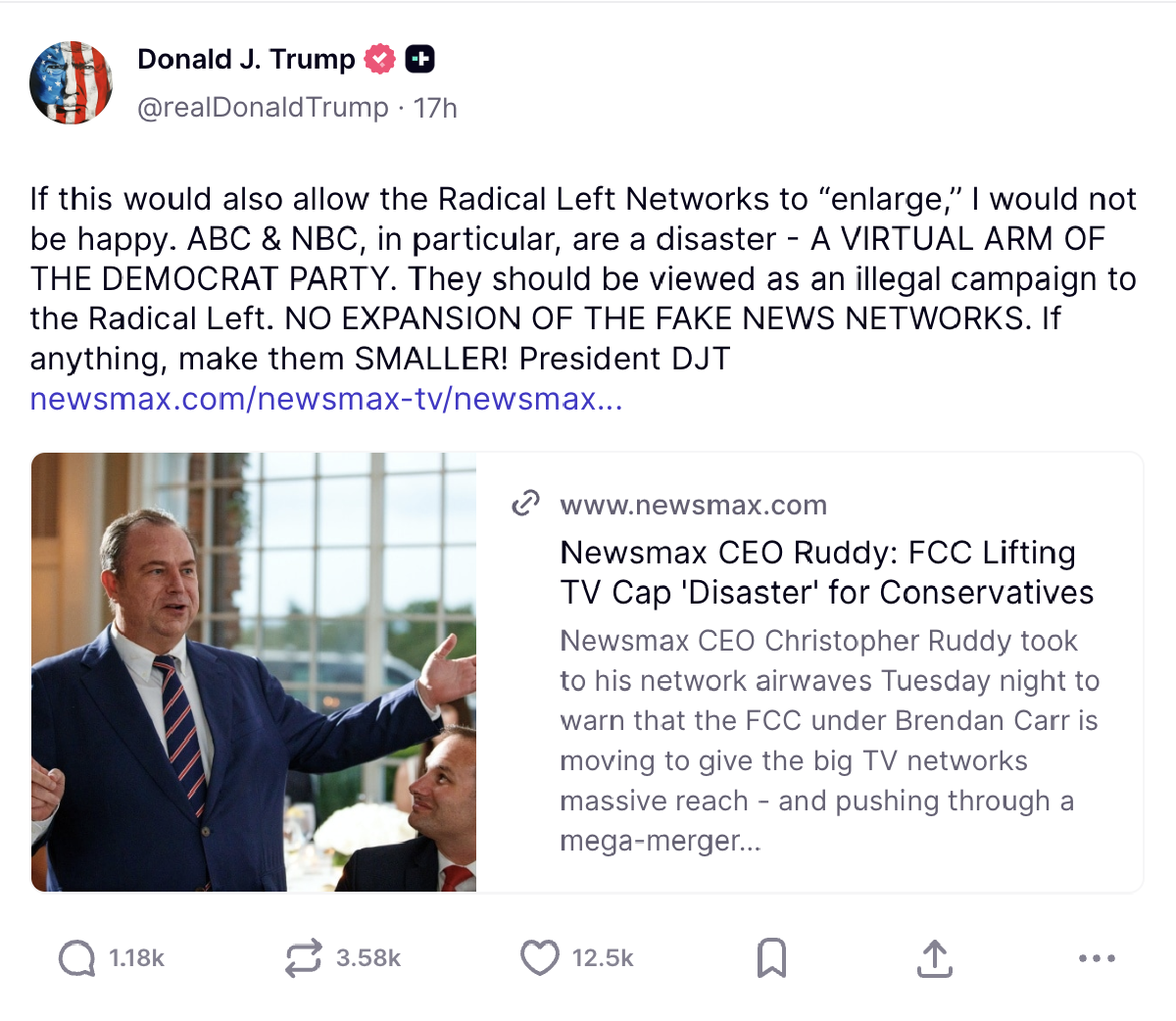
- President Trump appeared to side against reforming broadcast ownership rules in a post on Truth Social on Sunday.
- The post didn’t actually address local broadcast ownership rules; instead, Trump appeared to side against allowing ABC and NBC to grow larger, something that isn’t on the table.
- Local broadcasters like Nexstar, Sinclair and TEGNA were hammered on Wall Street one day after Trump’s social media post.
Shares of major broadcast television companies dipped slightly in early market trading on Monday after President Donald Trump appeared to voice his opposition to regulatory reforms that would allow independent owners of major network affiliates to consolidate in the near future.
The stock prices of Nexstar Media Group, TEGNA, Sinclair and the E. W. Scripps Company were all trading lower by around 3 to 5 percent by 10 a.m. Eastern Time (7 a.m. Pacific Time), one day after Trump took to his Truth Social platform to express concerns about attempts to lift an ownership cap that limits the number of local TV stations any one particular company may own outright.
Stock Price

Stock Price
Stock Price
Stock Price
All four broadcasters have voiced their support for reforming rules that would allow them to buy our sell parts of their operations. Nexstar and Sinclair, in particular, have supported lifting the current ownership cap, which currently prohibits one company from holding direct ownership of TV stations that reach more than 39 percent of the American population.

Last week, Nexstar submitted applications to the Federal Communications Commission (FCC) to acquire the broadcast licenses of peer TEGNA as part of a proposed $6.3 billion combination of the two companies. The applications come several months after FCC Chairman Brendan Carr announced the agency was launching a proceeding to evaluate broadcast ownership rules, with the possible goal of raising the cap or eliminating it outright.
Sinclair has similar business pending before the FCC as it seeks to swap or acquire local TV stations of its own. Both Nexstar and Sinclair have employed loopholes that allow them to have operational control of TV stations that are legally licensed to third party broadcasters on paper, which effectively allows them to circumvent the ownership cap without actually running afoul of existing ownership rules.
That arrange, which some have likened to a “sidecar,” comes with complicated financial disclosure and tax-related rules that broadcasters are hoping to eliminate by simplifying the process of direct ownership through regulatory reforms.
The proposal has the support of the National Association of Broadcasters (NAB), the largest lobbying group for the commercial broadcast industry. But it also has its opponents: Christopher Ruddy, the founder and CEO of Newsmax, has spoken against eliminating broadcast ownership rules, saying they are necessary to preserve competition in the space and asserting the FCC lacks the authority to lift ownership caps even if Carr wants. Newsmax competes in the cable news space against NewsNation, an upstart cable network owned by Nexstar.
Trump appeared to be swayed by the argument, but for different reasons. In a Truth Social post on Sunday, Trump linked to a recent Newsmax article featuring Ruddy’s opposition, writing that he was fundamentally opposed to “an illegal campaign by the radical left” to “enlarge” broadcast networks operated by ABC and NBC.

Trump has feuded with both networks before, suing ABC and the Walt Disney Company for perceived news distortion (the network settled the lawsuit) and threatening to do the same against NBC Universal and its owner Comcast. Neither network has expressed an interest to combine with another and, under current federal ownership rules, such a combination would be expressly prohibited (though the same FCC probe examining local media ownership rules is also considering whether regulations on broadcast networks should be eased as well).
Trump’s post appears to misinterpret Ruddy’s comments, which are largely based on reforming local broadcast ownership rules. The president made no comments specifically about local television stations.
Still, the market reacted as if he did, with local TV broadcast stocks down across the board as retail and some institutional investors pull their money out of fears that regulatory reform will be harder to push through.
Trump’s comments largely align with the views of Carr, who has expressed an interest in making things more difficult for the owners of broadcast networks, rather than easier. Last week, the FCC — at Carr’s direction — issued a public notice that announced a new investigation into the relationship between local TV stations and major broadcast networks.
The investigation followed numerous documented issues between broadcasters and networks over the past year, including a decision by Sinclair and Nexstar to pull ABC’s “Jimmy Kimmel Live” from around 60 local TV stations in September and ongoing fraught between local stations and ABC over higher affiliation fees and a decision to move more-premium programming to Hulu and Disney Plus.
More Stories
- Through public notice, Carr signals tougher rules on broadcast networks coming
- Nexstar readies FCC applications to acquire TEGNA stations
- Colorado lawmakers voice opposition to Nexstar-TEGNA deal
- Sinclair executive: Pulling Jimmy Kimmel was business decision
- Senator Ted Cruz to introduce bill curbing government censorship