



Key Points

- A Utah murder trial was briefly halted after Court TV accidentally broadcast the identity of an undercover police officer during live testimony.
- Judge Richard Mrazik ordered the network to stop transmitting and later asked outlets to edit or remove archived footage containing the officer.
- The incident comes weeks after Jellysmack acquired Court TV from Scripps and assumed operational control of the network.
A high-profile murder trial in Utah was briefly paused on Friday after Jellysmack-owned legal network Court TV accidentally broadcast the identity of an undercover police officer.
The incident happened during the trial testimony of Salt Lake City Police Sergeant Eric Haskell, who appeared as a witness in the criminal case of Kouri Richins.
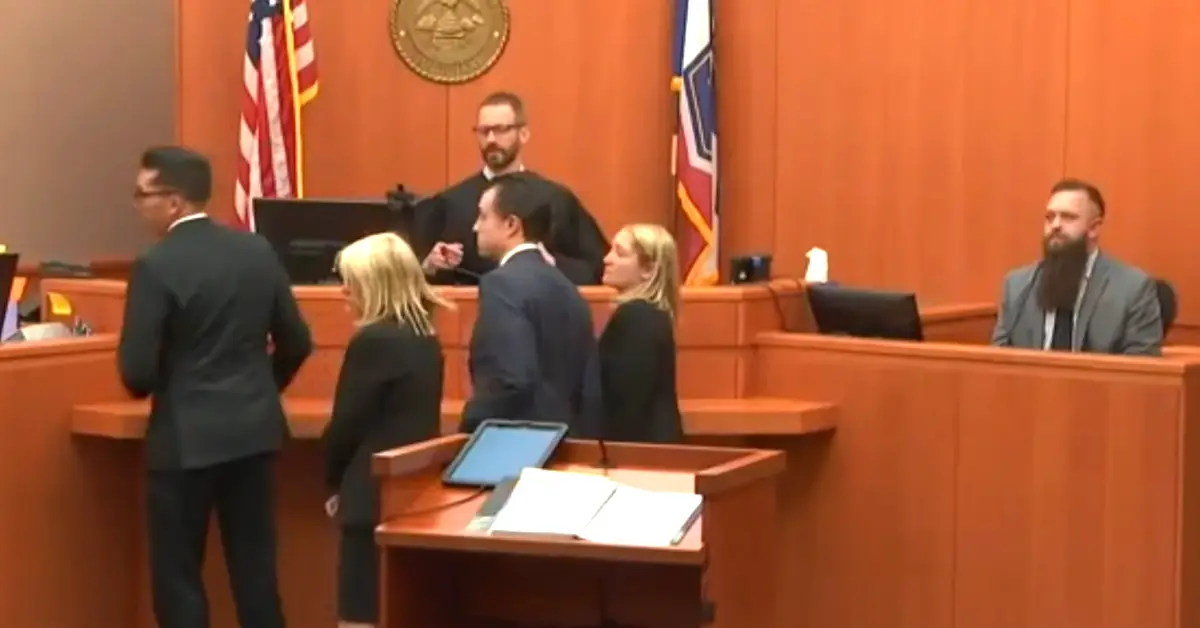
For more than five minutes, Haskell testified about the various techniques used by his undercover police unit to investigate and build criminal cases against drug dealers and organized drug operations before the judge overseeing the trial, Richard Mrazik, paused the examination.

Mrazik conferred with prosecutors and defense attorneys in the case first, then asked to speak separately with Grace Wong, Court TV’s Senior Director of Courtroom Coverage, before ordering the network to stop transmitting for an unspecified period of time.
Richins, a children’s book author, is on trial in connection with the drug-related death of her husband, Eric Richins. Prosecutors allege Kouri Richins poisoned Eric Richins with a lethal dose of fentanyl in order to collect death insurance benefits. She later authored a book aimed at helping children process trauma and grief.
Court TV is the sole media outlet producing in-courtroom coverage of the case. The network agreed to produce a “pool feed” that other broadcasters and news outlets may use without charge. Pool arrangements are common in state criminal trials, where judges want to limit the number of cameras and producers in a courtroom while granting broad public access to transparent proceedings via television.
The pool feed provided to TV stations at the Salt Lake City courthouse where Richins is standing trial included a graphic that warned no audio or video was permitted during Haskell’s testimony, according to two sources familiar with the matter, including a local TV station employee assigned to cover the case.
At the same time, Court TV transmitted an uninterrupted feed to its headquarters in Atlanta, which did not contain the same graphic when Haskell began talking, one source said. That version was then redistributed to other broadcast partners, which aired or streamed Haskell’s testimony until Mrazik stepped in.
“Court TV, I need you to stop recording and transmitting form this point forward until I tell you differently,” Mrazik ordered. The judge then turned to Haskell and said, “that is for your benefit.”
A court official later reached out to Court TV and local broadcasters with a request that live feed archives be edited to remove Haskell’s appearance or removed from the Internet if they could not be clipped, according to a local TV station employee who received the notice.
Haskell has been temporarily reassigned within the police department, a law enforcement source said. It was not clear if he would be removed from his undercover assignment permanently, or whether he plans any legal action against Court TV. (The Desk is identifying the officer because his name continues to appear in live blogs and news reports on the trial.)
The incident occurred about a month after Jellysmack agreed to acquire Court TV and its related assets from the E. W. Scripps Company. The transaction involves the relocation of Court TV’s transmission facilities from Atlanta to New York City, a process that is expected to be finalized by next Wednesday. Jellysmack already owns Law&Crime Network, which operates a separate linear TV network and produces clips of high-profile cases for social media.
In mid-February, Court TV’s digital producers were initially told that the network would no longer produce live video feeds for its YouTube channel and other digital properties, according to internal messages obtained by The Desk. The live feeds restarted two days later, after The Desk inquired about the halted broadcasts.
A spokesperson for the E. W. Scripps Company said the sale of Court TV to Jellysmack closed when the deal was announced in early February, and that Law&Crime Network is now in charge of the network. A publicity firm used by Jellysmack to handle corporate communications on behalf of Law&Crime and Court TV did not return multiple e-mails from The Desk for comment about last week’s blunder.