



Key Points

- Political ad spending will exceed $4 billion, a record for a non-presidential cycle, according to a new S&P Global Intelligence report.
- Competitive races and early campaign spending are driving strong demand for local TV inventory in key battleground states.
- Station groups like Sinclair, Inc., Nexstar Media Group and Gray Media are positioned to benefit most through their ownership or operation of TV stations in competitive local markets.
Local television broadcasters are on track for a strong political advertising cycle this year, fueled by competitive races for seats in the U.S. Congress, state gubernatorial elections and campaigns on social issues in key parts of the country, according to a new report released by S&P Global Intelligence.
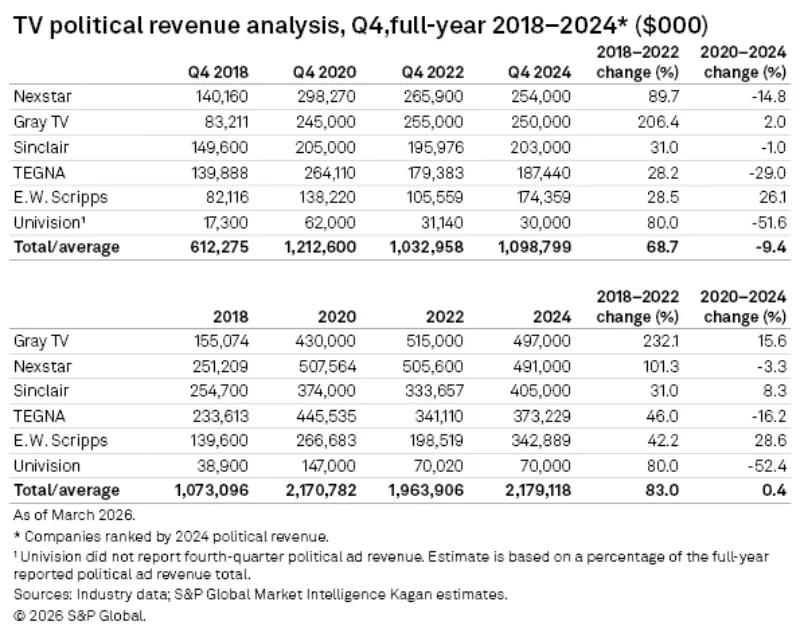
Political advertising is expected to eclipse $4 billion this year and account for 16.3 percent of total broadcast revenue, setting a record for a non-presidential election year and reinforcing its role as a key revenue driver for station groups amid softer core advertising trends, S&P Global Intelligence said.
The increase is being driven by a highly competitive election cycle, with 36 gubernatorial elections and a large number of open seats due to term limits and retirements. That dynamic is expected to intensify spending at the local level, particularly in battleground states including Arizona, Georgia, Michigan, Nevada and Wisconsin. Competitive Senate races in Texas, Maine and North Carolina are also contributing to higher ad demand.
Campaigns are also starting earlier and spending over longer periods, adding to total revenue. Control of Congress remains closely contested, pushing more national dollars into state and local races and boosting demand for local television inventory.
At the same time, the mix of political ad spending continues to shift. Connected TV (CTV) is the fastest-growing segment as campaigns seek more precise audience targeting, according to S&P Global Intelligence. Even so, linear television is expected to retain roughly half of all political ad dollars, which demonstrates its continued reach and scale, the intelligence firm said.
Broadcast groups are moving to capture that shift by expanding their digital and streaming capabilities, positioning themselves to compete for both traditional and CTV-based political budgets.
Station ownership in competitive markets will play a critical role in determining which companies benefit most. Sinclair, Inc. has the largest concentration of stations in swing states with 26 local TV outlets, followed by Nexstar Media Group and Gray Media with 23 each. (The count attributed to Nexstar does not include local TV stations being acquired from TEGNA, a deal that has been effectively paused through an antitrust lawsuit that is still playing out in court.)
Following its acquisition of Tegna, Nexstar now has the largest overall footprint of full-power stations in competitive markets, strengthening its ability to capture incremental political revenue.
Early results indicate the cycle is already ramping: Gray Media reported stronger-than-expected political revenue tied to late 2025 races and has guided to $25 million to $30 million in first-quarter 2026 political ad sales. Nexstar has also pointed to early contributions from state elections and ballot initiatives, while Sinclair expects 2026 revenue to be at least comparable to prior midterm cycles.
Looking ahead, S&P Global Market Intelligence projects continued growth, with local political ad revenue approaching $5.27 billion by the 2036 presidential cycle.
More Stories
- Gray Media CEO: Optimistic FCC will approve local TV swaps, acquisitions
- Gray Media sees lower revenue, but higher ad income, during Q4 (February 2026)
- Nexstar posts $83 million profit in 2025, despite lower overall revenue (February 2026)
- Sinclair logs financial loss during 2025, weak distribution fees weigh on revenue (February 2026)
- Winter Olympic Games pull in strong numbers for NBC affiliates
- Civil rights groups urge FCC to block TV station acquisitions
