


Key Points

- Netflix and WBD executives defended their merger to lawmakers, arguing it will boost competition against YouTube and Amazon.
- Sarandos pledged to offer theatrical releases for at least 45 days before streaming, breaking from Netflix’s traditional model.
- The combined company would capture 10.4 percent of TV viewing time, approaching YouTube’s 12.7 percent share.
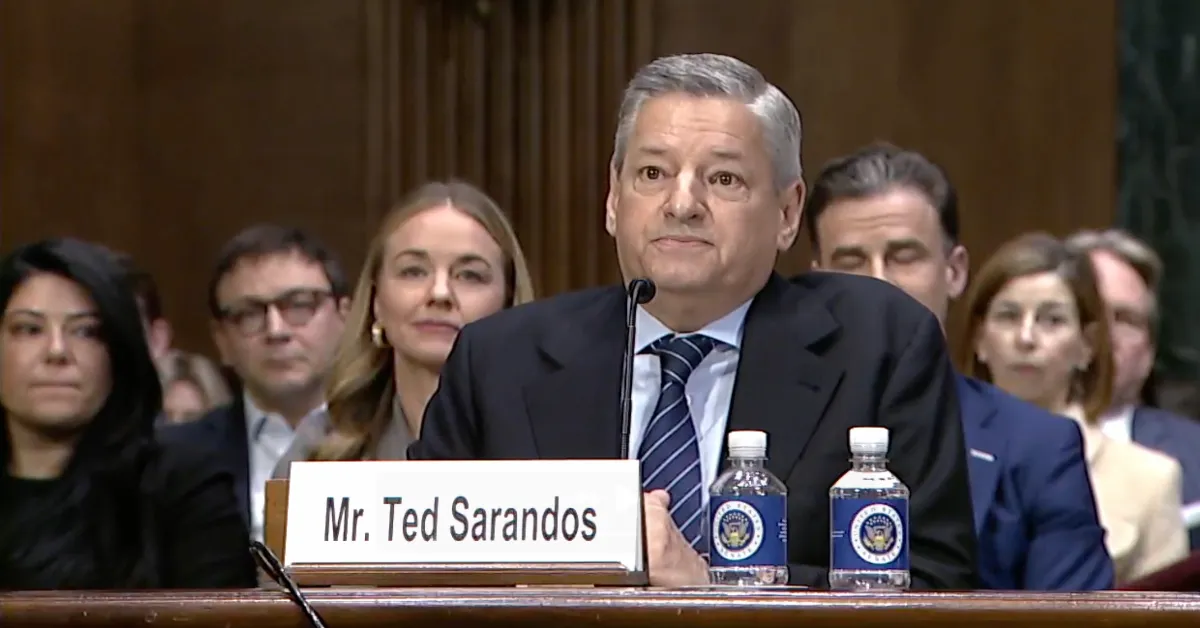
Executives from Netflix and Warner Bros Discovery (WBD) were on Capitol Hill on Tuesday, attempting to justify their proposed business transaction that could see the streaming juggernaut own historic intellectual property and a storied film studio business that dates back more than a century.
The executives, Netflix co-CEO Ted Sarandos and WBD Chief Revenue and Strategy Officer Bruce Campbell, did the best to justify their $72 billion agreement, saying the combination will increase competition overall while simultaneously allowing Netflix and the remaining WBD assets to better compete on their own.
The transaction is predicated upon WBD continuing with a plan to spin out their cable networks business into a separate company called Discovery Global, which will include CNN, TNT, TBS, Cartoon Network, Adult Swim, Animal Planet, Eurosport and Discovery Channel, among others.
“This is not a typical media merger,” Sarandos told lawmakers during the two-hour hearing. “We’re buying a company that has assets we do not.”
Responding to concerns that a combined Netflix will decimate the movie theater business, Sarandos reiterated a promise that the company will continue offering feature-length films to theaters for at least 45 days, after which those films will be eligible for distribution elsewhere, including its own service.
That breaks from Netflix’s long-standing model of developing films and TV shows that debut on its streaming platform almost exclusively, with just a handful of films offered to theaters after their initial run on the platform, largely for awards consideration.
“We will support theaters and keep growing the American entertainment industry,” Sarandos affirmed.
Both executives justified the combination as necessary in an era where multiple media players are present, including major technology firms like Google (owner of YouTube) and Amazon (Prime Video) compete with Netflix, WBD and others for attention, subscription fees and advertising dollars.
“Today, consumers can easily choose between broadcast, cable and streamers plus deep-pocketed tech companies that are trying to run away with the television business,” Sarandos noted.
To that end, Netflix said its biggest competitor isn’t Amazon and Disney, whose streaming products and business models are the same. Instead, Sarandos said Netflix primarily competes against YouTube, a free video sharing website where almost anyone can create and distribute content online.
According to Nielsen, YouTube is the top distributor of streaming content on television, and captures the largest share of TV time in American homes compared to other streaming services, even though YouTube doesn’t operate its business like other media companies.
Some lawmakers weren’t buying what Sarandos and Netflix were trying to sell.
“Netflix is the dominant streaming platform in my household and around our nation,” Senator Cory Booker of New Jersey said during the hearing. He noted that a combined Netflix and WBD would create a single entity that consists of “one of the largest content producers with one of the largest distributors.”
Senator Mike Lee of Utah also questioned why Netflix was analogous to YouTube.
“I’m struggling to grasp how it’s the same exact content,” Lee said, noting the difference between a blockbuster theatrical release and a short-form film on YouTube.
“It’s a zero-sum game,” Sarandos quipped. “If you’re watching YouTube, you’re not watching HBO, and you’re not watching Netflix.”
The transaction would, in fact, come close to disrupting YouTube’s dominance in the living room, based on recent Nielsen data. During Nielsen’s most-recent measurement month, YouTube accounted for 12.7 percent of all time spent with TV in American homes. Netflix and WBD accounted for 10.4 percent of TV time on a combined basis. Of the two, Netflix had the larger share at 9 percent; WBD’s share, at 1.4 percent, only counted HBO Max and Discovery Plus.
Federal regulators are examining the transaction now on a variety of elements, Sarandos affirmed on Tuesday. The company has held preliminary discussions with the U.S. Department of Justice on the matter, though Sarandos didn’t expand on those talks.
When asked if the proposed transaction might lead to job losses, Sarandos downplayed that concern.
“We do not believe our merger presents any consolidation risks,” he said.
Lawmakers aligned with the Trump administration used the opportunity to chastise both executives on various social issues, including their perceptions of the type of content found mostly on Netflix. Some questioned the editorial integrity of CNN, WBD’s cable network that operates as an independent unit within the company and which is not part of the Netflix transaction.

