

Countries in East Asia are catching up to the subscription ecosystem, fueled by a robust interconnected infrastructure and an appetite for content and gaming, according to the results of a new consumer survey by digital commerce firm Bango.
The report is the latest in a series of surveys that Bango has published under the “Subscription Wars” brand, which has revealed consumer subscription uptake, spending and fatigue in the United States, Europe and Latin America over the past year.
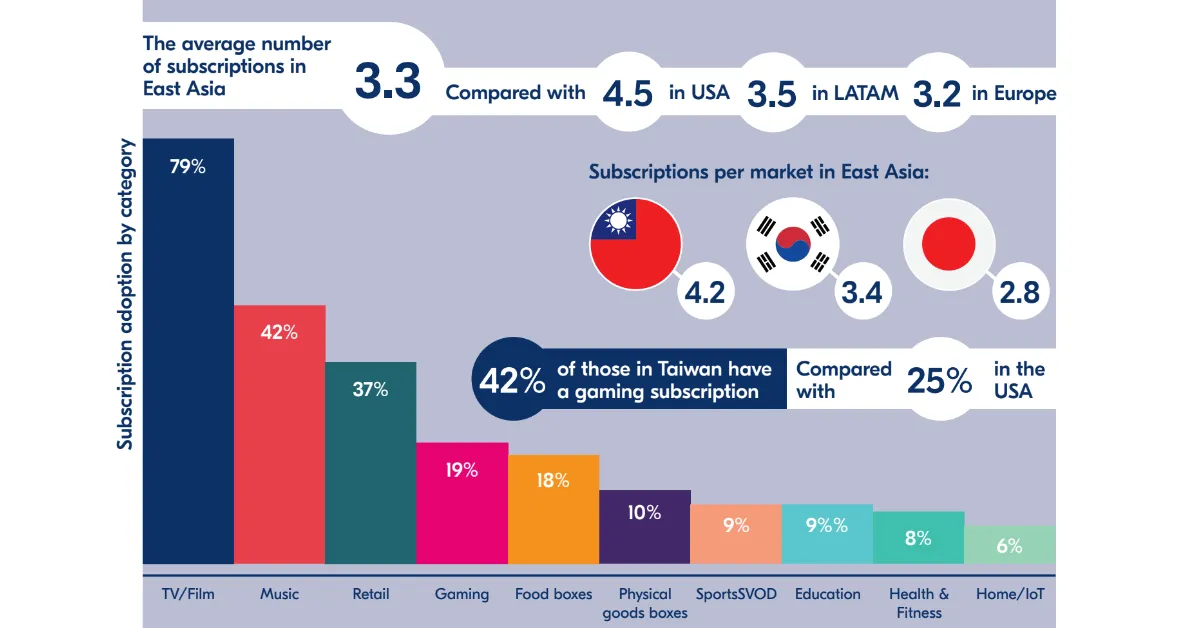
So, too, is the trend being experienced in East Asia, where the average household has 3.3 subscriptions, according to the Bango report. That is on track with Latin America and Europe, where households have around 3 subscriptions, and nearly on pace with the subscription leader of the world, the United States, where Americans have an average of 4.5 subscriptions.

Related: Bango releases global “Subscription Wars” report
Not surprisingly, video subscriptions are among the most-purchased in countries like Japan, South Korea and Taiwan, where 79 percent of households in the region have at least one video subscription. Music is a distant second with 42 percent adoption, followed by retail subscriptions at 37 percent and gaming at 19 percent.
Gamers in two countries — Japan and South Korea — “spend significantly more than the average subscriber,” the Bango report revealed, suggesting this is a good target demographic for products of a similar nature.
Over half those surveyed in East Asia say they have a “forever subscription” — a service they pay for that hey never intend to switch off. The figure — 53 percent — is lower than the 75 percent recorded in the United States, but it “still represents huge customer loyalty,” Bango concluded.
That said, consumers are only loyal to a point. Sixty-two percent of those surveyed in the East Asia market said they can’t afford all the subscriptions they’d like, about on track with how Americans feel. The figure tracks higher in Japan, where 67 percent said they can’t afford all the subscription services they’d like to purchase.

While ad-supported subscription video on-demand (aSVOD) services have become commonplace in the United States and are starting to have an impact in Europe and Latin America, aSVOD services are relatively new in East Asia. Still, 35 percent of those surveyed by Bango in the region said they’ve downgraded a premium subscription to an ad-supported tier in recent times, a figure that rises to 45 percent when focused on Taiwan alone.
The reason is obvious: As subscription video on-demand (SVOD) rates increase, consumers feel the pinch. While East Asia might have been one of the most-recent regions to receive access to aSVOD services, it was one of the first areas of the world to be afflicted by price increases on premium SVOD services, Bango concludes.
“As prices continue to rise, many are forced to cancel subscriptions or carefully choose which services to keep,” Bango says. “This is a challenge for subscription services, which must avoid pricing themselves out of the market.”
Ads help, and subscribers in East Asia seem to be welcoming them with open arms. Only around 23 percent of those surveyed in the region say they’ve dropped an SVOD service after it introduced ads — a lower rate than those in Latin America, where 44 percent dropped an SVOD service that introduced ads.
Another area where consumers in East Asia are like the rest of the world: They want a single platform where they can easily manage their subscriptions. Fifty-eight percent said they’re annoyed that they can’t manage their subscriptions in a single place. The number is on par with Europe, where 58 percent said they wanted a single platform to start and stop subscriptions, according to a report released by Bango last month.
How much do subscribers in East Asia want that centralized platform? Around four out of 10 people surveyed by Bango said they would be willing to leave their current telecom service provider if a competing one offered a centralized subscription hub, and 16 percent said they’d be willing to pay a higher Internet or mobile phone bill if it meant they could also buy subscriptions to other services through a hub offered by that provider.
Related: More streamers relying on subscription bundles, Magid says
Bango isn’t just putting out these data points because they’re interesting: The company develops and markets technology that allows telecom providers and others to offer third-party subscriptions that customers can purchase, with payments processed through the same bill they receive for their phone or Internet services.
Bango calls the idea “Super Bundling,” and the product that makes it possible is the “Digital Vending Machine.” In the United States, Verizon utilizes the Digital Vending Machine to offer its own Super Bundles that largely (but not exclusively) consist of streaming video apps. Verizon has also struck agreements with third parties to offer special pairings of services like the aSVOD versions of Netflix and Max, which cost subscribers just $10 per month. Similar bundles involve the premium versions of Netflix, Starz and AMC Plus.
“By creating all-in-one content hubs, [telecom service providers] can integrate multiple services into a seamless experience, addressing the complexity, billing issues and management frustrations voiced by subscribers,” Bango said in its recent report. “This [will] not only enhance customer satisfaction, but also strengthen the [telecom’s] position as the central players in the East Asian subscription market.”
Wireless providers are naturally the first service operators that come to mind when it comes to the idea of bundles, but Bango’s survey found consumer in East Asia are open to others providing those bundles, too.
Twenty-three percent of consumers surveyed in the region said they wanted their broadband Internet provider to offer a centralized subscription hub, while 10 percent said the same for traditional cable and satellite TV providers. Twenty-four percent said it made sense for a payment or wallet company to offer those types of platforms (Bango’s roots are in mobile payment processing, which remains a highly-utilized feature in Japan and other countries), while 18 percent said banks or credit unions should offer subscription platforms.
Regardless of who offers the platform, 60 percent of consumers in East Asia said they’d be more loyal to a brand that offered an all-in-one subscription management service, Bango said.
“The subscription economy in East Asia continues to evolve and diversify through an ever-growing number of services available to consumers, providing a significant opportunity for global players,” Andy Suzuki, the Senior Vice President of Bango’s Asia-Pacific business, said in a statement. “With demand for localized content and streamlined subscription management, Super Bundling offers a clear path forward for international businesses. By working with local telcos and tailoring services to consumer preferences, content providers can unlock new revenue streams and build lasting consumer loyalty.”
To read the full report, click or tap here.