



Key Points

- A report from Altman Solon says sports rights holders face a growing gap between audience reach and revenue in the streaming era.
- Streaming platforms are prioritizing premium rights, while digital creators expand reach but generate less monetization.
- Rights holders are exploring new revenue streams like direct-to-consumer services, data monetization and advertising.
Sports rights holders are facing a growing disconnect between audience reach and revenue as streaming platforms and digital creators reshape how live events and related content are distributed, according to a new report from Altman Solon.
The report, “Global Sports Survey: Unlocking the Full Value of Sports IP,” finds that while demand for sports content remains strong, the industry is entering a transitional phase where traditional monetization models are under pressure from evolving distribution dynamics and consumer behavior.
The findings are based on surveys of roughly 250 senior sports executives and 6,000 fans across six countries.

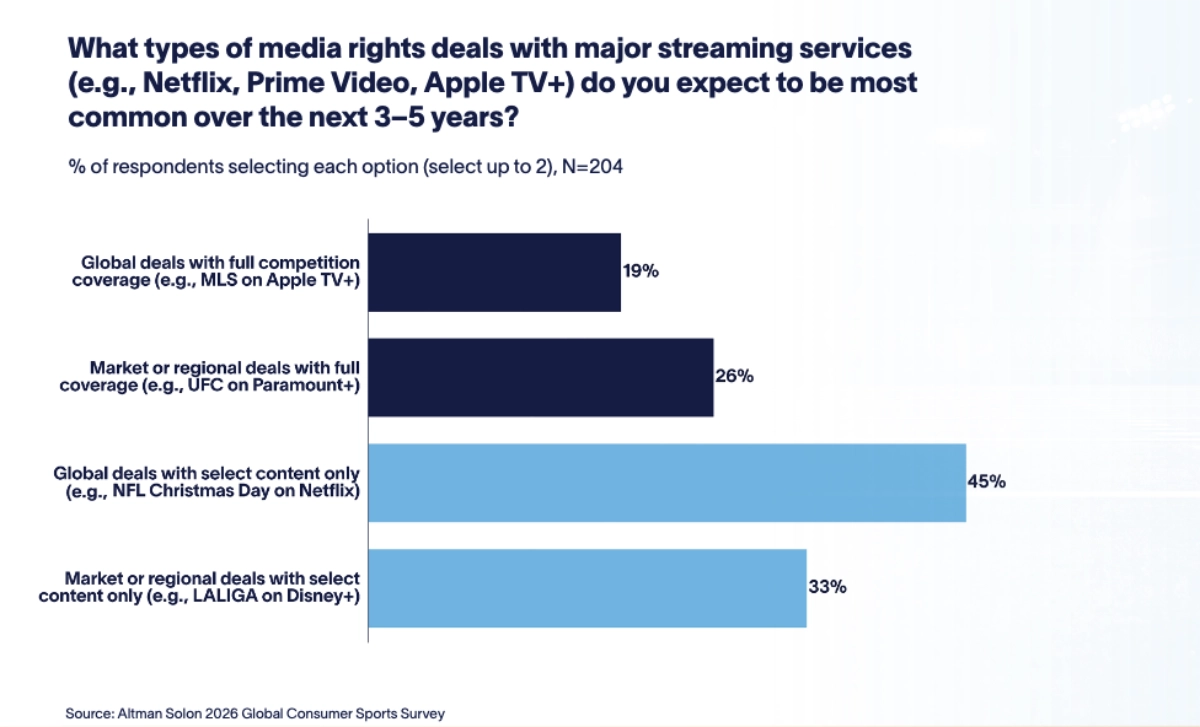
Streaming services are expected to play a central role in the next phase of sports media, but their investment strategies differ from legacy pay TV operators. Executives surveyed by Altman Solon said streamers are increasingly focused on acquiring premium, high-impact rights that support subscriber growth and advertising, rather than pursuing broad portfolios of sports content.
That shift is unlikely to replicate the peak economics of the pay TV era, when bundled channel distribution supported higher rights fees. Instead, direct-to-consumer economics and selective rights acquisitions are expected to constrain overall spending growth, even as competition for marquee events intensifies.
At the same time, streaming is rapidly gaining share of sports viewing. The report indicates that time spent watching sports on streaming platforms is nearing parity with linear television globally, with a crossover point expected as early as 2026. In markets like Spain and Italy, streaming has already overtaken traditional TV for sports consumption, reinforcing the need for multi-platform distribution strategies.
Digital creators are also emerging as a meaningful distribution channel. Leagues and rights holders are increasingly partnering with creators to expand reach, particularly among younger audiences, through highlights, shoulder programming and, in some cases, live game rights. These arrangements are helping to drive awareness and engagement, but monetization remains limited compared with traditional broadcast and streaming deals.
The report highlights a persistent gap between reach and revenue as content distributed across social and creator platforms delivers scale but generates lower direct returns. Willingness to pay for creator-led and short-form content remains below that of live games and traditional broadcasts, creating a near-term imbalance for rights owners, Altman Solon noted

To offset that gap, sports organizations are expected to accelerate efforts to diversify revenue streams. Direct-to-consumer initiatives — including subscription services, commerce and live experiences — were identified by 49 percent of executives as the most significant growth driver over the next three to five years.
Nearly two out of five survey participants said data monetization is emerging as a key opportunity, particularly in areas like targeted advertising, analytics and betting. Other areas of growth include advanced advertising formats, expanded licensing into gaming and experiential businesses and deeper integration of betting into live broadcasts.
Consumer trends are adding further complexity. While overall willingness to pay for sports content remains relatively strong, particularly among younger audiences, piracy continues to erode potential revenue. More than 20 percent of younger viewers report accessing sports through unofficial streams, highlighting both a loss of income and an opportunity to convert highly engaged fans through improved pricing and accessibility.
When it comes to sports, the media industry’s next phase of growth will be defined by its ability to convert expanded reach offered through traditional and streaming platforms into sustainable revenue, Altman Solon said.
As content distribution shifts toward platforms that prioritize scale over monetization, sports rights holders are increasingly positioning content as a marketing engine that supports broader commercial strategies, the intelligence firm offered.
The first and second portion of Altman Solon’s 7th edition of the Future of Sports Media is available to view by clicking or tapping here.
More Stories
- Altman Solon: Sports enters new growth cycle as viewing habits shift
- Fractured TV landscape for sports generates high interest in highlights
- Parks: Most fans keep sports streaming subscriptions active during off-season
- Hub: Sports fans still frustrated by broadcast, streaming TV deals
- TVB: Streaming is great, but most prefer watching live sports on broadcast