
Key Points

- A Bango study found 43 percent of U.S. consumers feel they pay for unused subscriptions, driving demand for usage-based billing and flexible payment models.
- Growing interest in AI-led discovery is reshaping the market, with 20 percent willing to let AI manage subscriptions and 27 percent open to paying for all-in-one platforms.
- Nearly one-third of Americans say they will only subscribe through bundles, signaling a market split between aggregators and standalone services.
Nearly half of consumers in the United States and United Kingdom feel they’re paying for subscriptions that they aren’t using on a regular basis, but their desire to maintain access to those apps and services leaves them looking for novel, more-affordable ways to continue their plans, according to a new report released by Bango this week.
The report, being discussed at Mobile World Congress in Barcelona this week, draws upon a recent survey of thousands of consumers in both countries and identifies three structural forces reshaping how subscriptions are sold, managed and monetized: Dynamic payment models, new discovery layers and a market split between bundlers and the bundled.
At the center of the shift is rising consumer frustration with fixed monthly fee: According to Bango’s research, 43 percent of Americans say monthly billing leaves them paying for unused time. As a result, many are seeking more flexible payment options that better reflect how they actually consume content.
Sixteen percent of Americans say they want subscriptions billed based on actual usage, such as time spent in an app. Twelve percent would prefer to pay per hour watched instead of committing to a monthly bill, while 7 percent would consider paying per minute viewed. One-quarter of survey participants said streaming services should reward consumers for binge-watching “streaks,” with the rewards taking different forms like unlocking discounts after watching a certain number of hours of a program or series of movies.
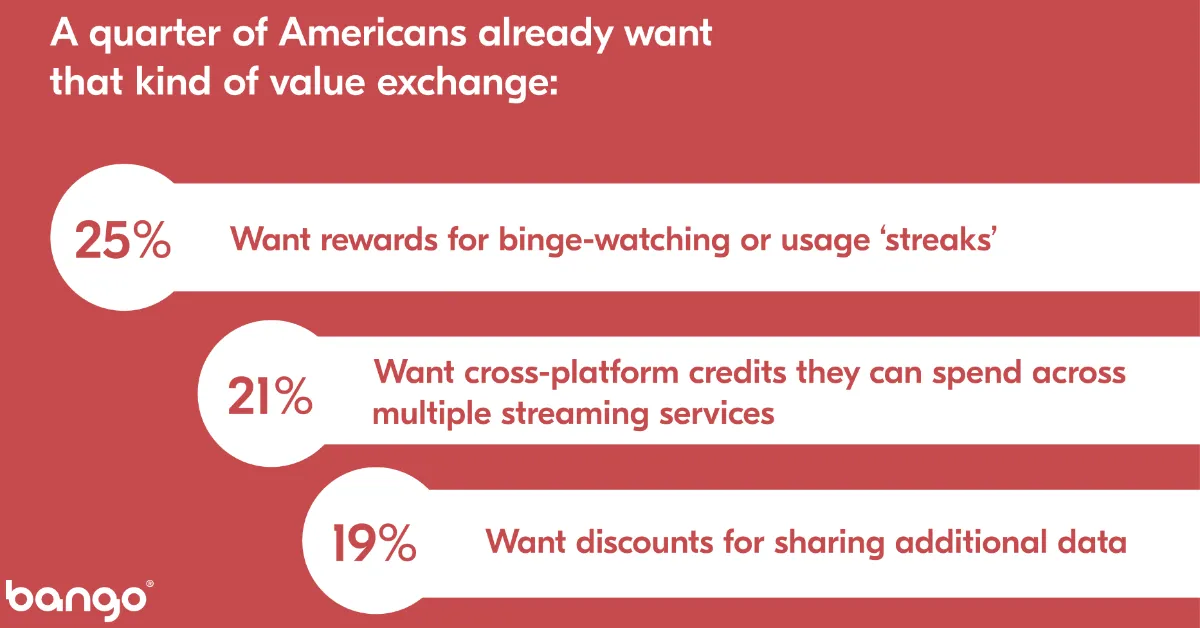
Consumers are also signaling a willingness to trade data for value: Nineteen percent say they would share additional viewing or watch history data if it unlocked better deals. Meanwhile, 21 percent want cross-platform credits that allow them to pay for content across multiple streaming services, and 20 percent would like those credits to apply across all of their subscriptions.
Beyond pricing, the report argues that discovery is shifting away from individual apps and toward devices, operating systems and AI agents that can recommend, activate and manage subscriptions on behalf of users.
Twenty percent of Americans say they would allow AI to automatically subscribe, manage and unsubscribe from services for them. Among Gen Z, that figure rises to 40 percent. More than a quarter, 27 percent, would pay a premium for an all-in-one platform that includes an AI agent capable of negotiating better rates or surfacing discounts, while 34 percent would prefer a single AI interface over opening multiple apps.
The research also finds that more than half of Americans, 58 percent, do not care which streaming service a show, film or song comes from, only the content itself. Twenty-eight percent rely on recommendations rather than actively searching, and 24 percent now use voice controls and rarely engage directly with apps.
That shift in behavior is contributing to what Bango describes as a market split. Nearly one-third of Americans, 31 percent, say they are done with standalone subscriptions and will only sign up if they can find a bundle or deal. The number climbs to 44 percent among Millennials and 48 percent among Gen Z.
More than a third, 35 percent, say they want a single sign-in and single monthly bill covering all streaming services, and 36 percent would like that simplicity extended across all subscription categories.
“Consumers want subscriptions to fit real life. People dip in and out of services, switch up what they watch, and expect pricing and perks to match that reality rather than a rigid monthly fee. They want one place to manage what they pay for, and they’re open to the next generation of subscription models that feel more flexible and rewarding, from binge-watch benefits and cross-platform credits to billing that flexes around usage,” Giles Tongue, the Vice President of Marketing at Bango, said in a statement. “
Tongue continued: “Our report highlights three forces shaping what comes next for subscription bundling: more dynamic payment beyond the monthly fee, new discovery via devices and AI, and a market that’s splitting into those that bundle and those that get bundled. We’re already seeing early signs of this shift. For traditional bundlers like telcos, owning discovery and making access and billing seamless is the chance to become the default destination for subscriptions in the future.”
“Advantage isn’t destiny,” Paul Larbey, the CEO of Bango, said in the report. “If telcos don’t move quickly to become the orchestrators of subscription access, they risk being reduced to a product inside someone else’s experience.”
The full report is available to download by clicking or tapping here.