


Key Points

- A VAB report found most U.S. voters regularly use ad-supported TV and streaming platforms to discover political candidates.
- Television remains the most-trusted news source, with voters far more likely to trust TV than social media or artificial intelligence tools.
- Viewers exposed to political messaging on TV are more likely to engage, seek information and take action.
The majority of committed or prospective voters in America regularly engage with advertising-supported television channels and platforms, according to a new report from the Video Advertising Bureau (VAB).
The report, released on Tuesday, is based on the findings of a consumer survey involving more than 2,300 Americans over the age of 18. The report was focused on finding commonality in media trends among potential and non-voters alike, and across different political groups.
Among survey participants who identified as actual or prospective voters, most say they subscribe to some form of pay television or streaming service, including traditional cable, satellite and streaming cable-like alternatives.
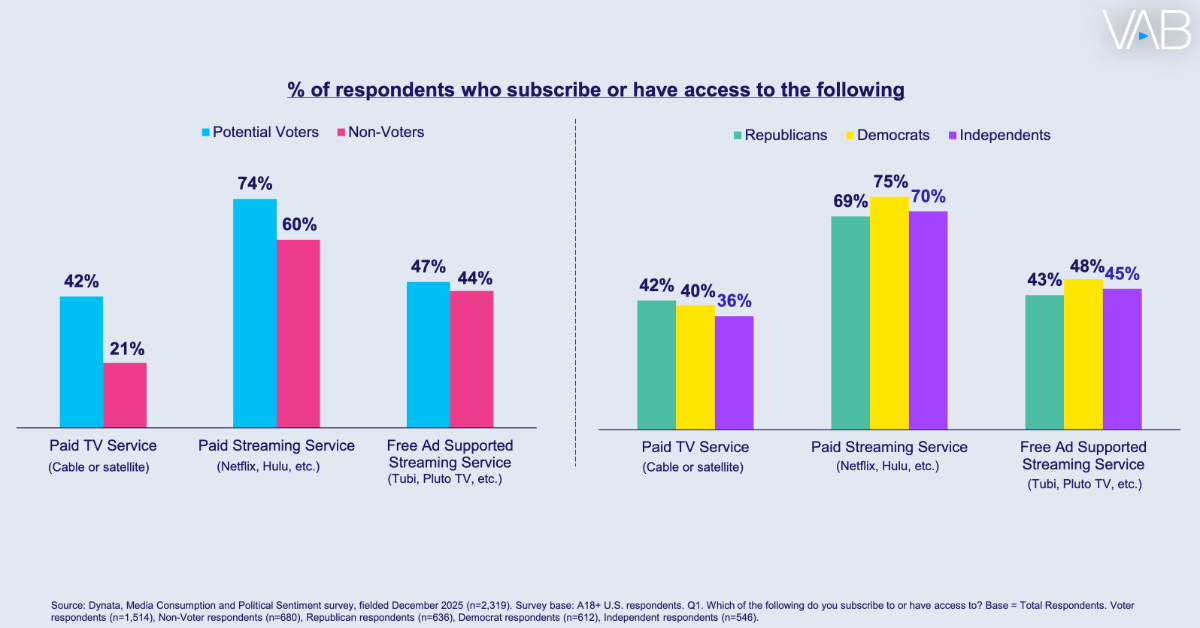
TV and streaming platforms are the primary discovery channels for political candidates and their causes, the VAB report said, and most voters prioritize how a candidate addresses different political issues rather than the party to which they’re affiliated.
After finding a candidate on TV, voters are likely to engage with them on social media — but TV is the first stop toward that engagement, VAB contends. At the same time, respondents expressed skepticism toward digital platforms: Social media was far more likely than television to be viewed as a source of misleading or false information, with potential voters much more likely to identify social platforms as unreliable.
Trust in TV news significantly exceeds that of digital platforms. Potential voters are nearly nine times more likely to trust television news than social media, while half of respondents ranked artificial intelligence tools as the least trustworthy source of information. The report also found audiences rely on TV news more than any other platform to stay informed about political issues, with voters far more likely to turn to television than social media.
“Today’s voters, regardless of political involvement or party affiliation, move fluidly across trusted multiscreen TV platforms, spanning both linear and streaming, to stay informed on current events and political issues,” said Jason Wiese, the Executive Vice President of Strategic Insights & Measurement at VAB. “TV news delivers the scale, trust, credibility and authenticity that no other media can for both political and non-political advertisers.”
Beyond awareness, the report finds television environments influence consumer behavior. Viewers exposed to advertising within TV news are more likely to take action, including seeking additional information or making purchasing decisions. Potential voters, in particular, show a higher likelihood of buying products advertised alongside breaking news coverage.
VAB said multiscreen TV offers advertisers a combination of trust, reach and engagement that is difficult to replicate on digital platforms alone. The report also notes that entertainment and sports programming can extend campaign reach beyond news, providing additional opportunities to connect with audiences.
The full VAB report is available to view by clicking or tapping here.
More Stories
- VAB: Premium streamers outperform YouTube in advertising effectiveness
- YouTube nukes 179 million problematic videos over six years
- Study: TV remains most-important ad platform across purchase funnel
- Consumers shifting toward ad-based streaming platforms amid rising costs
- Roku hires executive from Snap to lead global media revenue unit