


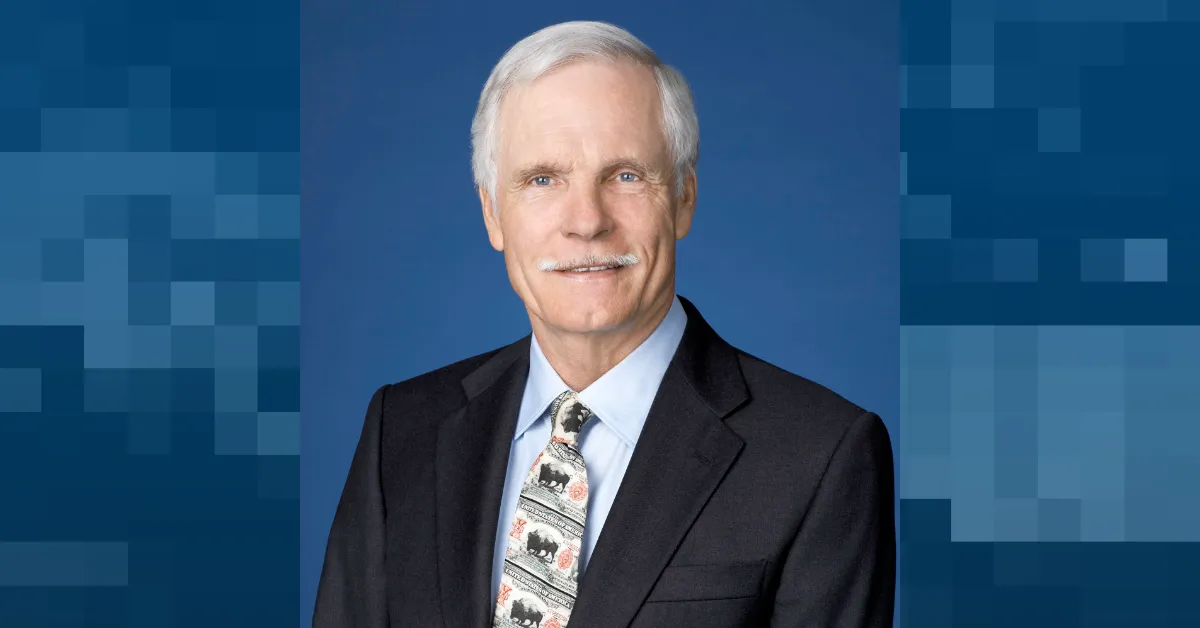
Ted Turner, the brash media entrepreneur who helped invent modern cable television by turning a small Atlanta station into the WTBS superstation and later launched the first 24-hour news channel called CNN, died Wednesday at his home near Tallahassee, Florida.
Turner was 87 years old. No cause of death was released by Turner Enterprises, which provided the news first to CNN.
Turner’s legacy rests primarily on two foundational bets: that a local TV station could become national through satellite distribution, and that television news could run around the clock. Both ideas were dismissed as risky, even reckless. Both reshaped the media business.

After inheriting and expanding his father’s billboard company, Turner moved into broadcasting in 1970, buying a struggling Atlanta television station he renamed WTCG (Channel 17). The station lacked money, programming and audience, but Turner saw an opening in the emerging cable business. He used sports, old movies and reruns to fill airtime cheaply, then took on more debt to beam the station by satellite to cable systems across the country.
That move created what became WTBS, later TBS, the nation’s first major cable “superstation.” At a time when cable operators needed programming to persuade households to subscribe, Turner’s Atlanta station became essential. Its mix of Braves baseball, Hawks basketball, films and syndicated shows gave cable systems a national channel with a local flavor and a reliable schedule.
Turner deepened that strategy by buying the Atlanta Braves in 1976 and the Atlanta Hawks in 1977, using the teams as programming engines for his station. Broadcasting Braves games nationally helped fill WTBS’s schedule and gave the team extraordinary exposure, eventually making the Braves known as “America’s Team.”
His bigger and more consequential gamble came on June 1, 1980, when he launched CNN from Atlanta. At the time, the three broadcast networks dominated TV news, delivering fixed evening newscasts to mass audiences. Turner’s idea was radically different: a cable channel devoted entirely to news, available 24 hours a day.
CNN began with fewer than two million subscribers and struggled with low budgets, technical problems and skepticism from rivals who mocked it. But Turner believed immediacy would become television news’ defining advantage.

“We won’t be signing off until the world ends,” he said before the launch. (A few years ago, a former CNN intern, Michael Ballaban, leaked a copy of a video that CNN held in its archives that was to be played immediately before the world ended. Ballaban now works for the network as a senior editor of news and special projects.)
The network found its identity through wall-to-wall coverage of major events, including the Challenger disaster, the fall of the Berlin Wall and the 1991 Gulf War. During the Gulf War, CNN’s reporting from Baghdad gave it a global profile and proved the value of live, continuous news coverage.
Time Magazine named Turner its Man of the Year in 1991, declaring CNN the “video medium of record.”
CNN also expanded the model Turner had pioneered with WTBS: cable channels built around distinct brands, distributed nationally and eventually globally. CNN Headline News and CNN International followed, while the broader Turner Broadcasting System grew to include TBS, TNT, Cartoon Network and Turner Classic Movies.
Turner later sold Turner Broadcasting to Time Warner in 1996, folding his cable empire into one of the world’s largest media companies. But by then, his core innovations were already embedded in the business: satellite-distributed cable networks, nationally televised local sports and news delivered live whenever it happened.