


Key Points

- Broadcast TV had the lowest Super Bowl LX latency at about 19 seconds behind live action, beating cable and streaming platforms, according to Stats Perform.
- Cable TV followed at 38 seconds of lag, while streaming leader Peacock delivered the fastest stream at 48 seconds behind the field.
- Stats Perform said Super Bowl LX latency was measured using real-time spotters comparing on-field action with broadcast, cable and streaming feeds.
Broadcast television had the lowest amount of “lag” between the time a play was made on the field at Super Bowl LX and the time it was shown to TV viewers across the country, according to a new report issued on Monday.
The report, from Stats Perform, showed broadcast TV was around 19 seconds behind on-field action at Levi’s Stadium in the San Francisco Bay Area, putting broadcast TV ahead of all other platforms, including cable and streaming services.
It was the first time that Stats Perform evaluated broadcast TV against other platforms since the report launched two years ago. Last month, Stats Perform acquired Phenix, a tech company focused on reducing streaming-related latency across channels and services. Phenix produced the report in 2024 and 2025.
The evaluation used real-time spotters at Super Bowl LX who compared on-field action to a variety of platforms where the big game was offered.
Broadcast aside, cable TV had the least amount of latency between an on-field play and the time it was shown to viewers at home, clocking in at 38 seconds behind the action at Levi’s Stadium.
Among streaming services, Comcast’s Peacock had the least amount of latency, clocking in at 48 seconds behind the on-field action, according to Stats Perform. Comcast-owned NBC had the rights to Super Bowl LX and offered a national feed of the game to all Peacock subscribers. Those with Peacock Premium Plus also had access to a stream of their local NBC station or affiliate.
Peacock’s streaming lag was respectable, but higher than Fox-owned Tubi, which offered a national feed of Super Bowl LIX in 2024. According to Phenix, Tubi’s national feed had just 26 seconds of lag time between an on-field play and the moment it was shown across devices. Peacock beat Paramount Plus from two years earlier, which offered Super Bowl LVIII from CBS with a lag time of just over 48 seconds.
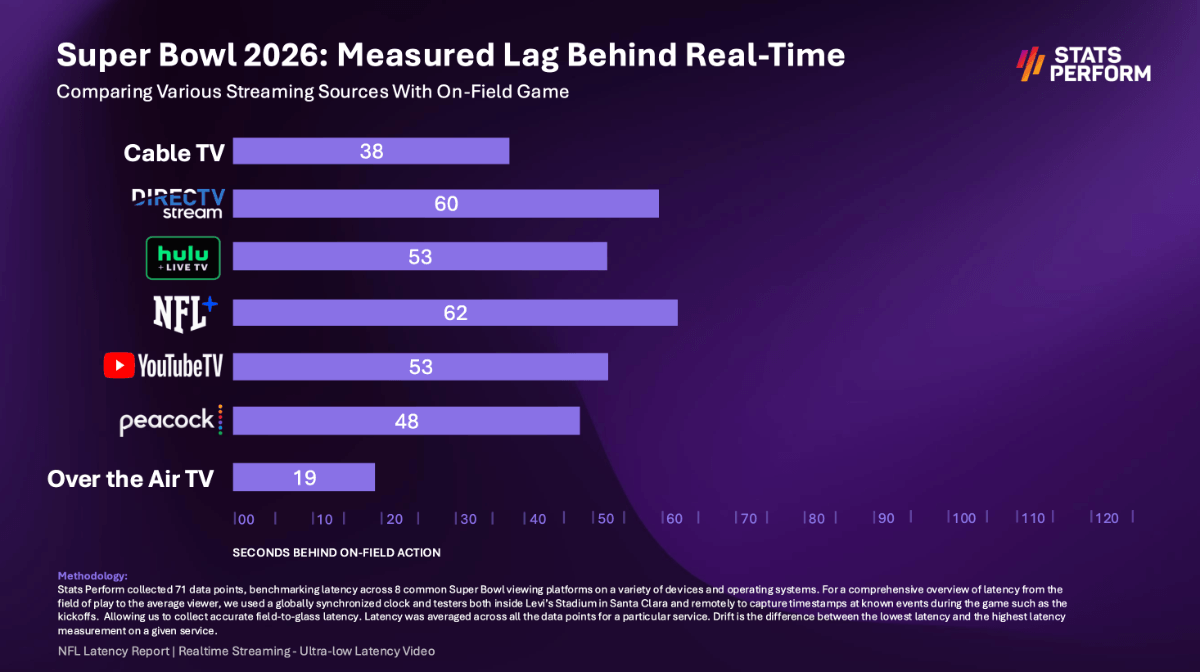
Across cable-like streaming services, Disney’s Hulu with Live TV and Google-owned YouTube TV had the lowest lag time at 53 seconds each, followed by DIRECTV’s streaming platforms, which was behind by a full minute. Fubo, a sports inclusive service measured by Phenix in 2024 and 2025, wasn’t measured this year because the service doesn’t offer NBC.
Monday’s report from Stats Perform initially included a measurement for Tubi, which didn’t offer Super Bowl LX. After The Desk spotted the error, a spokesperson said some of its spotters mistakenly reported YouTube TV’s lag as Tubi.
The full report from Stats Perform is available to view by clicking or tapping here.