

Key Points

- U.S. digital video ad spending will reach about $82 billion this year, up 11 percent from last year, according to a new IAB report.
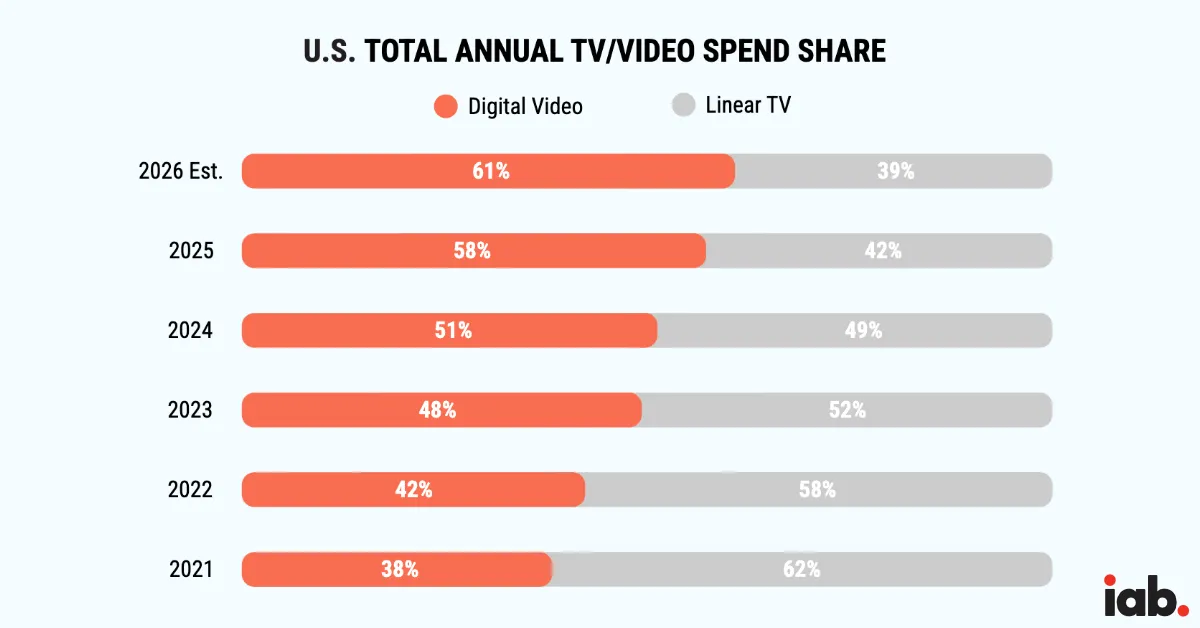
- Digital video is expected to account for more than 60 percent of total TV and video ad spending for the first time.
- Advertisers are increasingly prioritizing targeting and AI tools to improve campaign performance amid market fragmentation.
U.S. digital video advertising is expected to surpass $80 billion this year, doubling in size from five years ago as marketers and ad buyers continue to shift money away from traditional TV campaigns into streaming, social and online video, according to a report released by the Interactive Advertising Bureau (IAB) this week.
The report projects digital video ad spending will reach nearly $82 billion this year, up 11 percent from the near $74 billion earned last year. The growth rate is nearly 20 percent faster than the overall ad market, IAB noted, though it reflects a slower pace of spending than the post-pandemic acceleration from just a few years ago.
Digital video is expected to account for 61 percent of total U.S. TV and video ad spending this year, IAB said, marking the first time that digital video represents more than 60 percent of the market. The figure is up from 58 percent last year and 38 percent in 2021.

The continued shift comes despite a year when large cyclical event like the Olympics, FIFA World Cup and the midterm elections would typically support linear television spending. But the migration of those events to streaming platforms, including through programmatic ad opportunities, is helping digital video gain share even in a cycle that has historically favored traditional TV, IAB noted.
Social video is expected to remain the largest digital video category after surpassing connected TV in 2025. The report projects social video ad spending will reach $31.9 billion in 2026, compared with $29.3 billion for online video and $20.7 billion for connected TV. Social video’s growth is being fueled by AI-powered personalization, creative optimization, measurement tools and the expansion of the creator economy, the report said.
Connected TV (CTV) continues to grow as well, supported by live sports, professionally produced entertainment and stronger evidence that the channel can deliver measurable business outcomes. The adoption of CTV ad buys is also being helped by greater investment from smaller advertisers, with the share of small spenders investing in CTV rising from 60 percent in 2024 to 85 percent in 2026, IAB affirmed.
Consumer packaged goods and retail remain the largest categories for digital video advertising. CPG spending is projected to reach $16.9 billion this year, followed by retail at $9.4 billion, tech at $7.5 billion and both pharmaceutical and entertainment and media at $7.4 billion. Automotive is the only category expected to decline, falling 2 percent amid higher vehicle prices, interest rates, a softer employment outlook and tariff pressure.
Targeting capabilities surpassed content quality as the top criterion for spending decisions, cited by 49 percent of respondents. Content quality was cited by 46 percent, followed by overall reach at 39 percent, guaranteed business outcomes at 36 percent and price efficiency at 32 percent.

The rise of targeting reflects growing concern over signal loss tied to IP degradation and AI-driven traffic, which can make reliable audience targeting more difficult, IAB said in the report. The shift was especially pronounced among small and mid-size spenders, who increased their emphasis on targeting by 23 percentage points year over year.
The report also examined the role of agentic AI in digital video campaign execution. Two-thirds of buyers said they are already live, testing or planning to use agentic AI for digital video campaigns in 2026. Another 28 percent said they are actively investigating or evaluating the technology, while just 6 percent said it was not on their roadmap.
Current and planned use cases are concentrated in decision-support functions rather than final purchasing decisions. Media planning and buying recommendations, inventory discovery and evaluation and creative testing or optimization were each cited by about half of respondents who are testing, planning or live with agentic AI.
Small and mid-size spenders are more likely to use AI for creative testing, performance analysis and media pre-planning, areas where the technology can replicate internal infrastructure they may lack. Larger advertisers are more focused on inventory discovery and evaluation as they navigate fragmentation across private marketplaces, direct deals and open auction environments.
Advertiser Perceptions and Guideline helped produce the IAB report, which is available to view by clicking or tapping here.