

Key Points

- Paramount’s proposed merger with Warner Bros Discovery would create a streaming footprint reaching about 57 percent of U.S. households.
- The combined platform scale would rival competing streaming products offered by Netflix, Amazon and Disney, which have stronger broadband reach.
- Paramount has not finalized how it will integrate services like Paramount Plus and HBO Max if the deal closes; the transaction still faces scrutiny from state and federal regulators.
Paramount’s aggressive bid to acquire Warner Bros Discovery (WBD) wouldn’t just give the combined company a stronger position in the film and television production business, it would also extend the reach of its combined streaming properties at a time when competition in that sector is hot, according to a new report from Parks Associates.
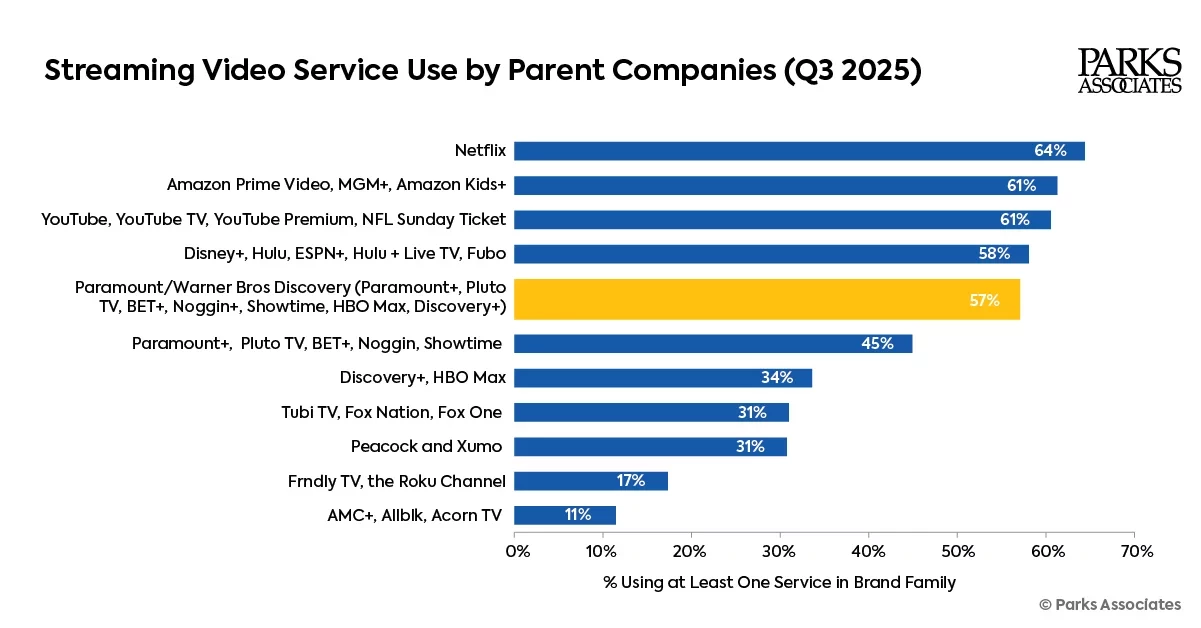
The combined streaming businesses of Paramount and WBD would reach more than 50 percent of U.S. broadband households, aligning the reach of those products with competing streaming platforms operated by Netflix, Amazon and the Walt Disney Company, Parks Associates noted in their report on Monday, shared first with The Desk over the weekend.
Parks Associates equated “reach” with adoption in U.S. households. All told, Paramount and WBD’s combined streaming platforms — which include Paramount Plus, Pluto TV, HBO Max, Discovery Plus and some ancillary services — will be used in 57 percent of American homes, compared to Netflix at 64 percent, Amazon’s streaming services at 61 percent and Disney’s streaming platforms at 58 percent. (Disney’s streaming products include two premium live TV services.)

On their own, Paramount is the stronger of the two companies in the streaming sector, with its connected TV apps reaching 45 percent of U.S. broadband households, according to Parks Associates data. By comparison, WBD’s streaming platforms HBO Max and Discovery Plus are currently used by 34 percent of streaming households. Around one in ten streamers use Paramount’s streaming services, but not those offered by WBD, the data showed.
The report comes at a time when Paramount’s proposed $110 billion acquisition of WBD continues to face scrutiny in Washington and from regulators in some states. In February, California Attorney General Rob Bonta said his office was examining the deal on antitrust grounds, an indication that the state is considering a lawsuit to block the deal. Paramount and WBD operate major film and TV studios in California, and Paramount owns six local TV stations in three California cities.
Executives at Paramount have justified the combination as necessary to preserve the businesses of two legacy companies at a time when the entertainment industry has faced strong disruption.
“By bringing together these world-class studios, our complementary streaming platforms, and the extraordinary talent behind them, we will create even greater value for audiences, partners and shareholders — and we couldn’t be more excited for what’s ahead,” David Ellison, the CEO of Paramount, said in a statement when the deal was announced.
Michael Goodman, the Director of Entertainment Research at Parks Associates, suggested the combined Paramount-WBD was rooted in a broader trend of media companies offering differentiated streaming services to reach consumers across price points.
“There is a clear shift in how consumers engage with streaming content,” Goodman said in a statement on Monday. “Unless you are Netflix, it’s no longer about a single flagship service: Success increasingly depends on building a broad ecosystem of complementary offerings that keep viewers within a single brand family.”
To that end, Paramount has not offered much insight into how it plans to operate its own streaming products alongside those of WBD if the deal secures all approvals and ultimately closes. Last October, Ellison said he was interested in merging HBO Max into Paramount Plus — an unusual move, since HBO Max has a larger global subscriber count. Later, Ellison said HBO Max and Paramount Plus would maintain separate subscriptions — a streamer could buy access to HBO Max content without purchasing a subscription to Paramount Plus, and vice-versa — but didn’t promise that they would remain unique services.
Parks Associates plans to release additional data and insight during the 9th annual Future of Video conference in Marina Del Rey, California from November 17 to November 18. The agenda for the Future of Video conference was released this month and is available to view by clicking or tapping here. The Desk is an editorial partner of Future of Video.